Augmenting The Future Of Retail

Published on

November 20, 2025

11/20/25

Nov 20, 2025

Reading Time

5 mins

Retail design is increasingly less about transactions and more about brand immersion: storytelling, lifestyle, and exclusivity. Today’s consumers expect more from brands than ever before. They seek immersive, personalized, and memorable journeys that engage multiple senses and blur the line between online and offline shopping. Deloitte’s 2025 Global Gen Z and Millennial Survey reveals that Gen Z increasingly prioritizes experiences that offer purpose, emotional resonance and personal meaning over traditional material rewards. Flagship retail stores are typically the first to address these needs. They often blend culture and entertainment to create unforgettable brand destinations, tailored to their location: tapping local heritage, art, and architectural motifs. This makes each flagship feel unique and rooted in place.

In luxury and sports retail especially, in-store digital experiences are no longer added value, but core components of the customer journey. Multi-sensory design (sound, scent, touch, lighting, immersive video, and spatial audio) can be used to deliver richer storytelling that connects with customers at deeper emotional levels, enveloping them in branded stories that can transcend them to virtual worlds. I had the amazing opportunity a couple of years ago to work on immersive retail experiences for Canada Goose, a visionary luxury outerwear brand.

Immersive Crevasse

From the moment you enter “The Journey Experience” flagship in Toronto, you are transported to a sensory-filled arctic adventure. Customers enter through a long narrow crevasse with rock-like walls. The floor comes to life with digital screens underneath glass that simulates cracking ice as customers step. Overhead a holographic LED fan installation features custom northern lights Interstitials. Spatial audio, accent lighting, scents, and theatrical effects provides a sensory-rich experience.

Experiential retail is quickly becoming the new normal. Dialing up branded storytelling is a practice sometimes referred to as “retail theatre”. I first read this expression many years ago in one of my favorite books on this topic The Experience Economy written by Joseph Pine and James H. Gilmore. In the book they highlight the major economic era we live in, The Experience Economy, where brands stage memorable events for customers, treating retail as theatre, goods as props and services as the stage. All with the aim to engage customers personally, creating an emotional, physical, or intellectual memory that transforms them, commanding a higher economic value than goods or services alone.

Retail design is increasingly less about transactions and more about brand immersion: storytelling, lifestyle, and exclusivity. Today’s consumers expect more from brands than ever before. They seek immersive, personalized, and memorable journeys that engage multiple senses and blur the line between online and offline shopping. Deloitte’s 2025 Global Gen Z and Millennial Survey reveals that Gen Z increasingly prioritizes experiences that offer purpose, emotional resonance and personal meaning over traditional material rewards. Flagship retail stores are typically the first to address these needs. They often blend culture and entertainment to create unforgettable brand destinations, tailored to their location: tapping local heritage, art, and architectural motifs. This makes each flagship feel unique and rooted in place.

In luxury and sports retail especially, in-store digital experiences are no longer added value, but core components of the customer journey. Multi-sensory design (sound, scent, touch, lighting, immersive video, and spatial audio) can be used to deliver richer storytelling that connects with customers at deeper emotional levels, enveloping them in branded stories that can transcend them to virtual worlds. I had the amazing opportunity a couple of years ago to work on immersive retail experiences for Canada Goose, a visionary luxury outerwear brand.

0:00 / 0:00
Immersive Crevasse

From the moment you enter “The Journey Experience” flagship in Toronto, you are transported to a sensory-filled arctic adventure. Customers enter through a long narrow crevasse with rock-like walls. The floor comes to life with digital screens underneath glass that simulates cracking ice as customers step. Overhead a holographic LED fan installation features custom northern lights Interstitials. Spatial audio, accent lighting, scents, and theatrical effects provides a sensory-rich experience.

Experiential retail is quickly becoming the new normal. Dialing up branded storytelling is a practice sometimes referred to as “retail theatre”. I first read this expression many years ago in one of my favorite books on this topic The Experience Economy written by Joseph Pine and James H. Gilmore. In the book they highlight the major economic era we live in, The Experience Economy, where brands stage memorable events for customers, treating retail as theatre, goods as props and services as the stage. All with the aim to engage customers personally, creating an emotional, physical, or intellectual memory that transforms them, commanding a higher economic value than goods or services alone.

Immersive Crevasse

From the moment you enter “The Journey Experience” flagship in Toronto, you are transported to a sensory-filled arctic adventure. Customers enter through a long narrow crevasse with rock-like walls. The floor comes to life with digital screens underneath glass that simulates cracking ice as customers step. Overhead a holographic LED fan installation features custom northern lights Interstitials. Spatial audio, accent lighting, scents, and theatrical effects provides a sensory-rich experience.

Experiential retail is quickly becoming the new normal. Dialing up branded storytelling is a practice sometimes referred to as “retail theatre”. I first read this expression many years ago in one of my favorite books on this topic The Experience Economy written by Joseph Pine and James H. Gilmore. In the book they highlight the major economic era we live in, The Experience Economy, where brands stage memorable events for customers, treating retail as theatre, goods as props and services as the stage. All with the aim to engage customers personally, creating an emotional, physical, or intellectual memory that transforms them, commanding a higher economic value than goods or services alone.

Authenticity in Motion

Increasingly shortened attention spans, constant cultural shifts, immediacy of information, and implications that AI is having on brand authenticity have given way to new strategies in modern retail marketing. Pop‑ups, events, and even physical retail space as a media buy are new channels that can be leveraged both for buzz and as testbeds for more permanent locations. To truly connect with today’s young consumers however, these require a similar cultural connection and the type of immersive storytelling found in online gaming and mixed reality. If that wasn’t challenging enough, they must be “delivered at the speed of culture”, meaning that brands must rapidly deliver these experiences, responding to evolving cultural trends, social media shifts, and consumer sentiment. This requires a digital experience strategy, leveraging new technologies, embracing dynamic content creation, and developing organizational flexibility to stay ahead of rapid cultural changes.
Experiential Retail Evolution

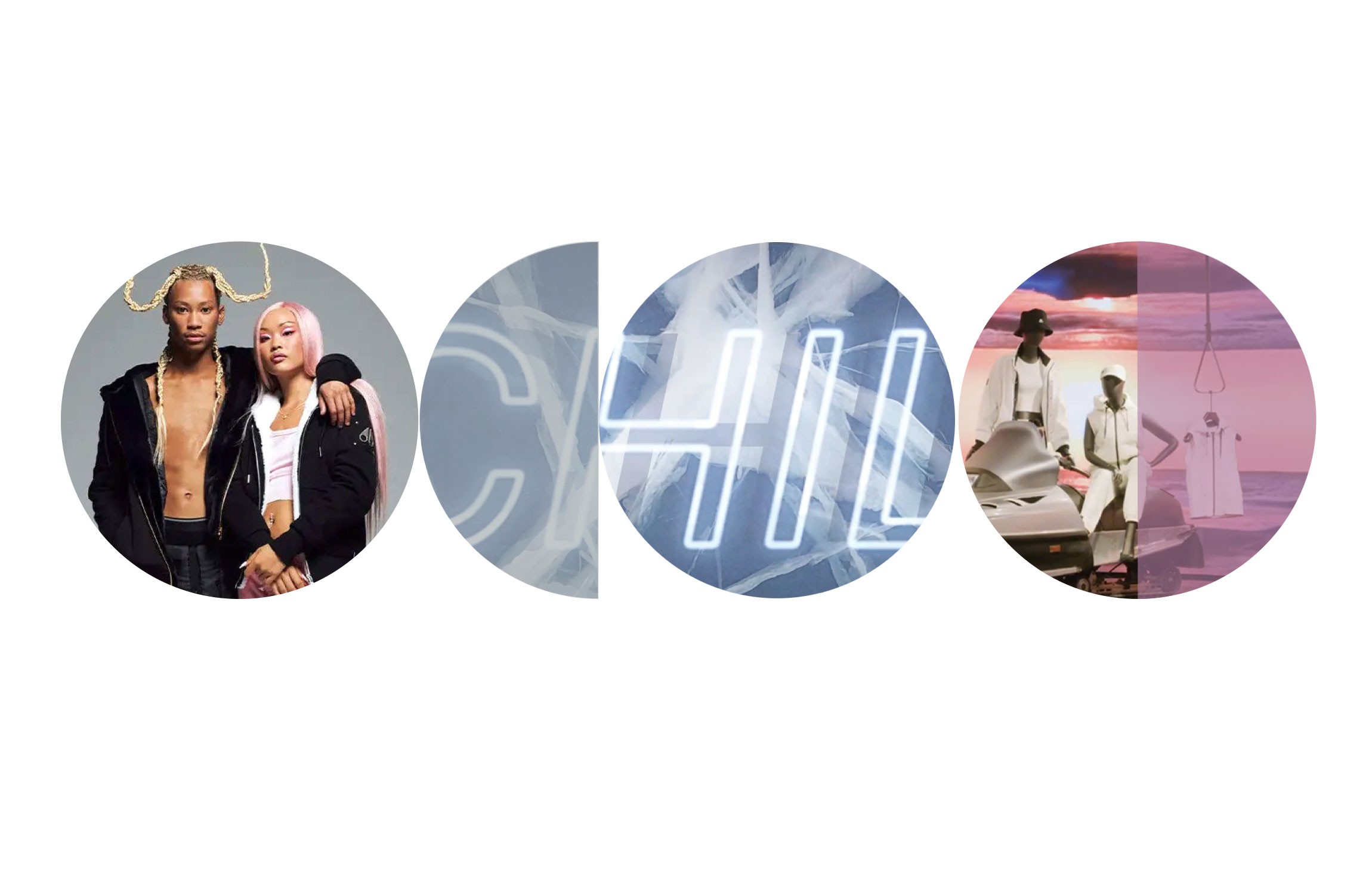
With the retail landscape shifting so quickly, brands can no longer rely on outdated transactional shopping experiences to keep customers engaged. Today’s consumers expect more from both temporary activations and permanent retail locations. They want immersive, experiential environments that elevate shopping through entertainment, cultural connection, and social engagement. Retail stores must evolve into destinations that offer unique, digital and interactive experiences. Technological advancements, and the increasing demand for more meaningful personalized shopping journeys demand that brands embrace experiential retail to thrive, while those that fail to innovate risk becoming obsolete.
Evolving Display Technology

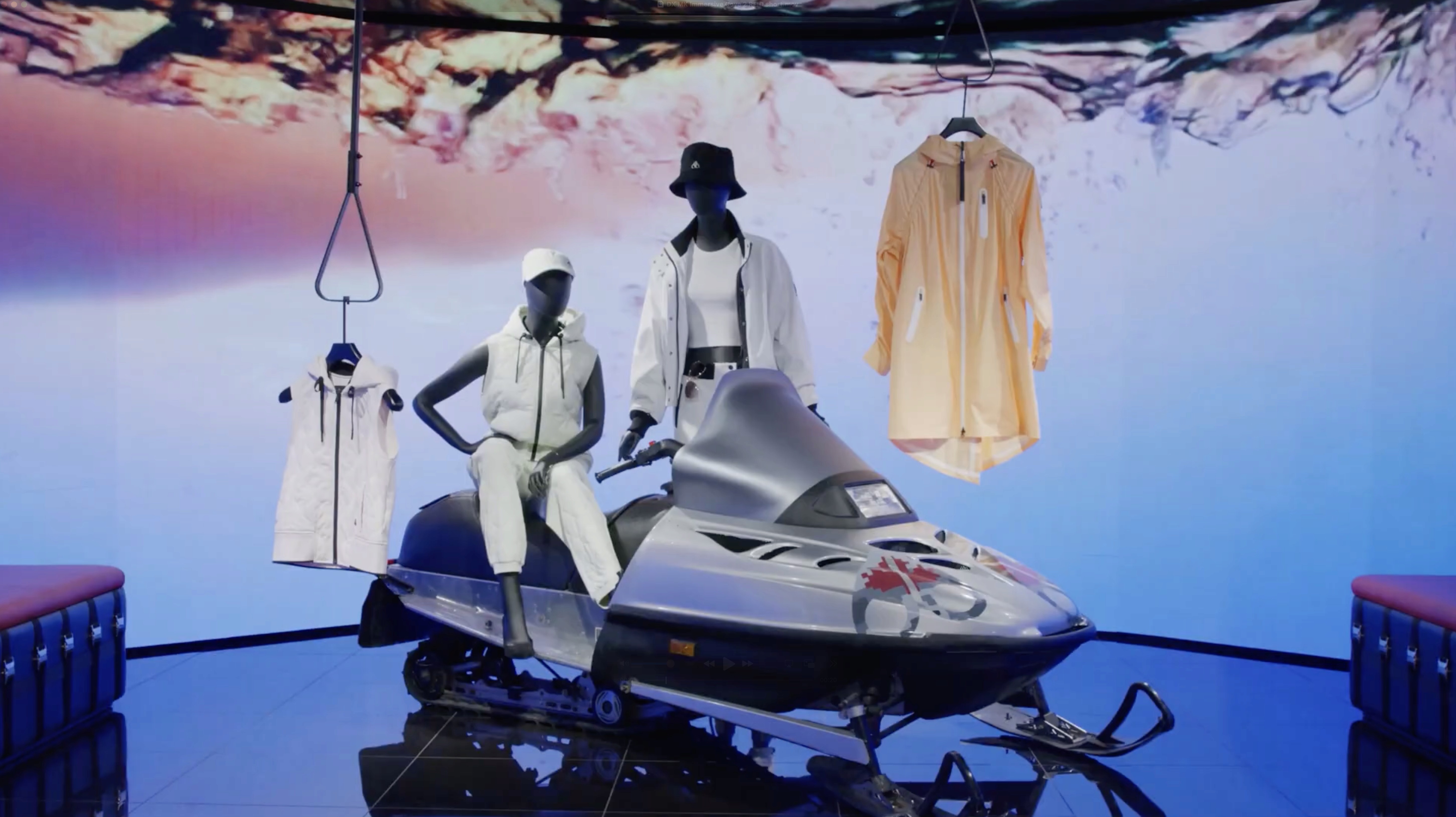
Display technology is evolving at a rapid pace, providing larger canvases, hyper realistic resolutions, curved surfaces, and even transparency, that can augment physical environments. Brands are now able to go bigger and bolder with technology to stage experiences that keep consumers engaged longer in hopes of owning more of their valuable time and spend. We are seeing more experiential retail stores focused on delivering brand stories, personalization, and building community culture that allow transactions to take place in the customers preferred channel as part of a unified-commerce methodology. “Immersive Coves” are a great way to devote a relatively small area of a retail store to create an environment that can engage customers, surrounding them in digital storytelling. In this example below, my team was challenged to re-invent existing structural space for a new luxury retail flagship. We had to rethink a fitting room vestibule from a previous tenant’s design and maximize the area to deliver an affordable immersive experience that reduced demolition costs while providing a highly visible destination in the rear of the store that could be utilized for branded storytelling. A curved LED cove surrounds an almost complete diameter, while a highly reflective floor and ceiling help to envelop visitors.
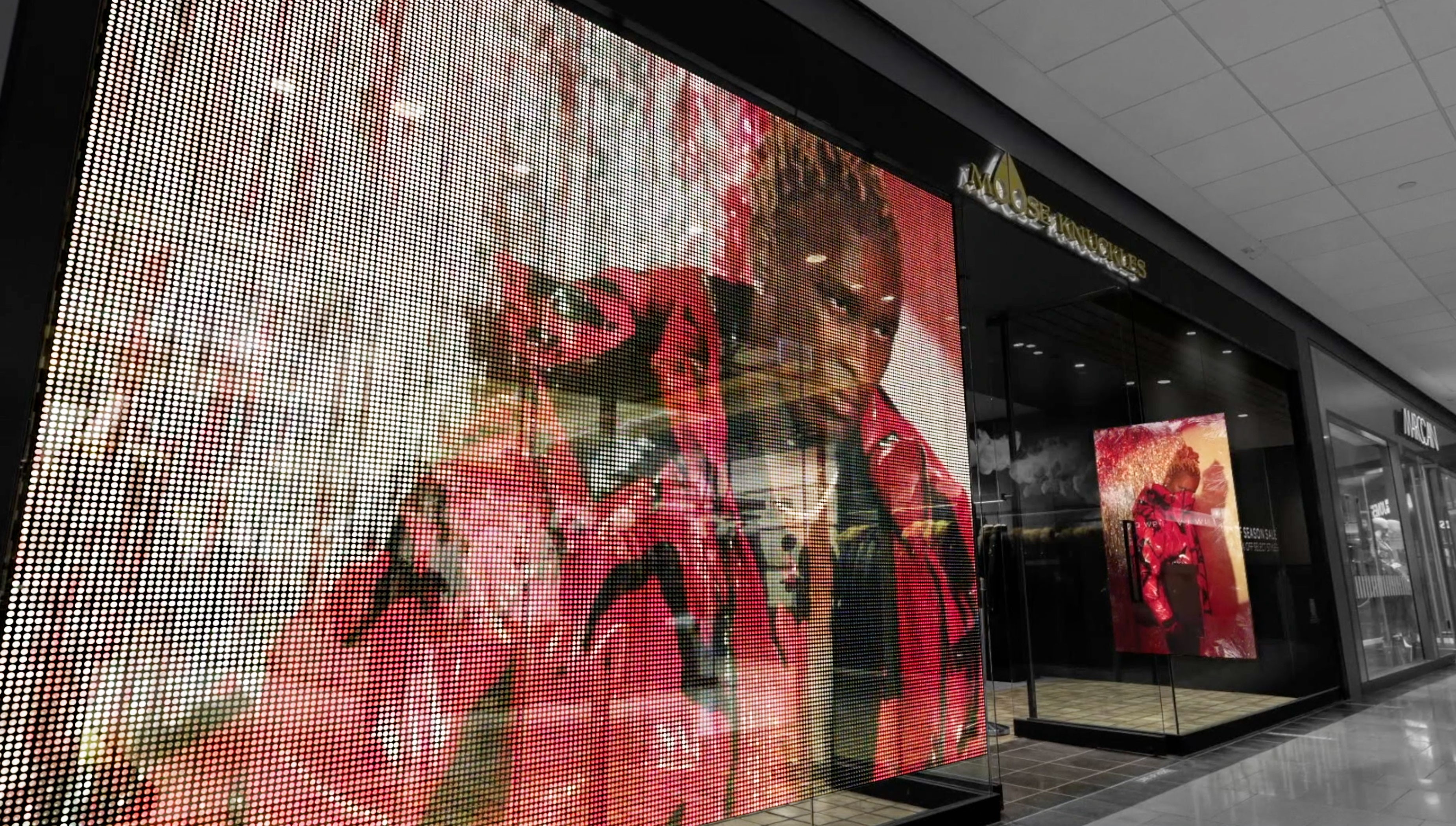
I am quite passionate about transparent display technology, having worked with it for several years now. With many formats now well established like Transparent OLED, Micro LED, Film, Mesh, and Glass, these canvases are revolutionizing interior spaces. The technology allows designers to integrate them seamlessly into architectural elements such as store fronts, windows, partitions, and even unique sculptural installations. This medium requires new approaches for designing content. Maximizing transparency by allowing areas in the content to be completely see-through, allowing visibility into the retail store behind is vital.
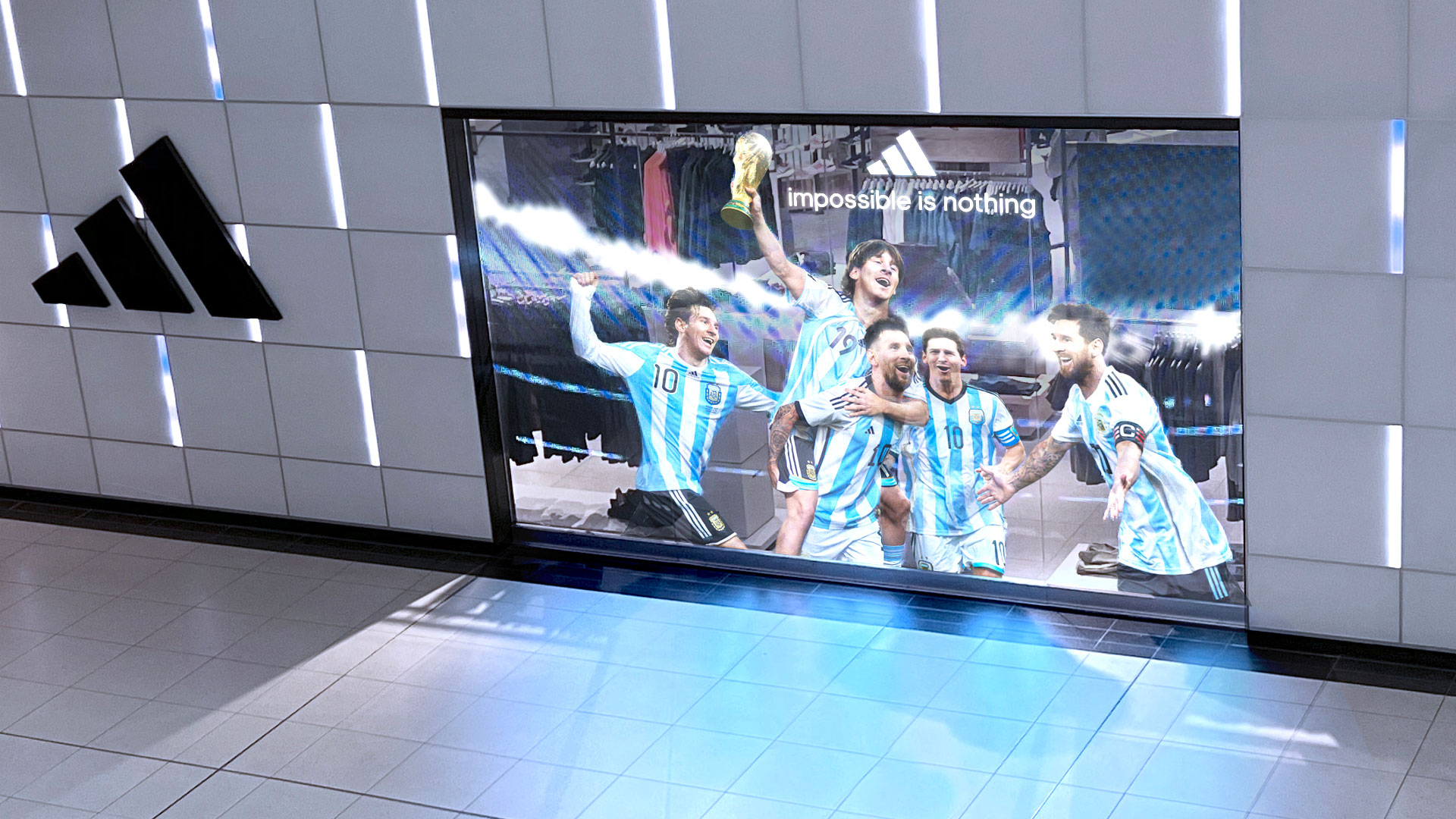
I have had the amazing opportunity to work with adidas for many years across a couple of firms, helping them shape their digital at retail strategy. In prompt reaction to Argentina’s FIFA World Cup victory, my team designed a transparent LED glass content interstitial inspired by adidas tagline “Impossible Is Nothing”. Our piece featured Lionel Messi, adidas’ flagship athlete depicted at various stages of his career chasing international glory. Utilizing parallax animation, pseudo 3D, and forced perspective techniques we delivered a transparent “holographic effect” at the store front, that stops visitors in their tracks and draws them in to the store.
Augmenting Spatial Design

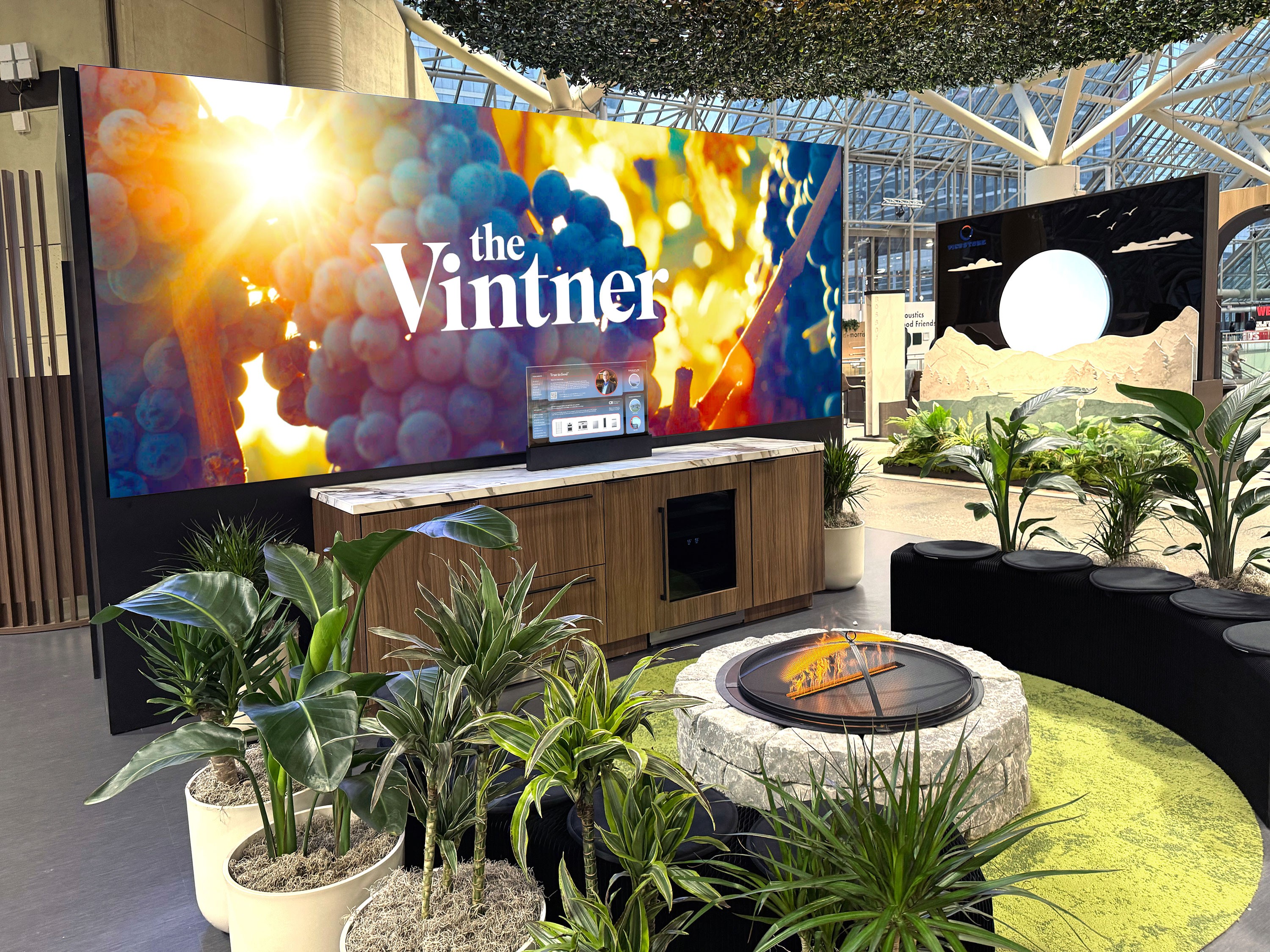
Transparent display technology requires a very different approach than conventional LED displays. Designers must carefully balance the benefits of transparency with practical considerations to ensure optimal user experiences and long-term viability. Good design is always human-centered. The placement of content has a big effect on how people react comfortably to it. For interactive experiences involving transparent displays, layering UI elements within shells, windows, nav bars, and tabs, can help users feel comfortable with interfaces that feel familiar. Surface materials and UI elements simulating glass can provide transparency and be augmented through shading, opacity, and blur sometimes referred to as “Glass morphism”. Considering key spatial UI (user interface) design principles like depth, dimension, and scale can all aid experiential designers to strategize human-centered experiences for augmenting both virtual and physical spaces.
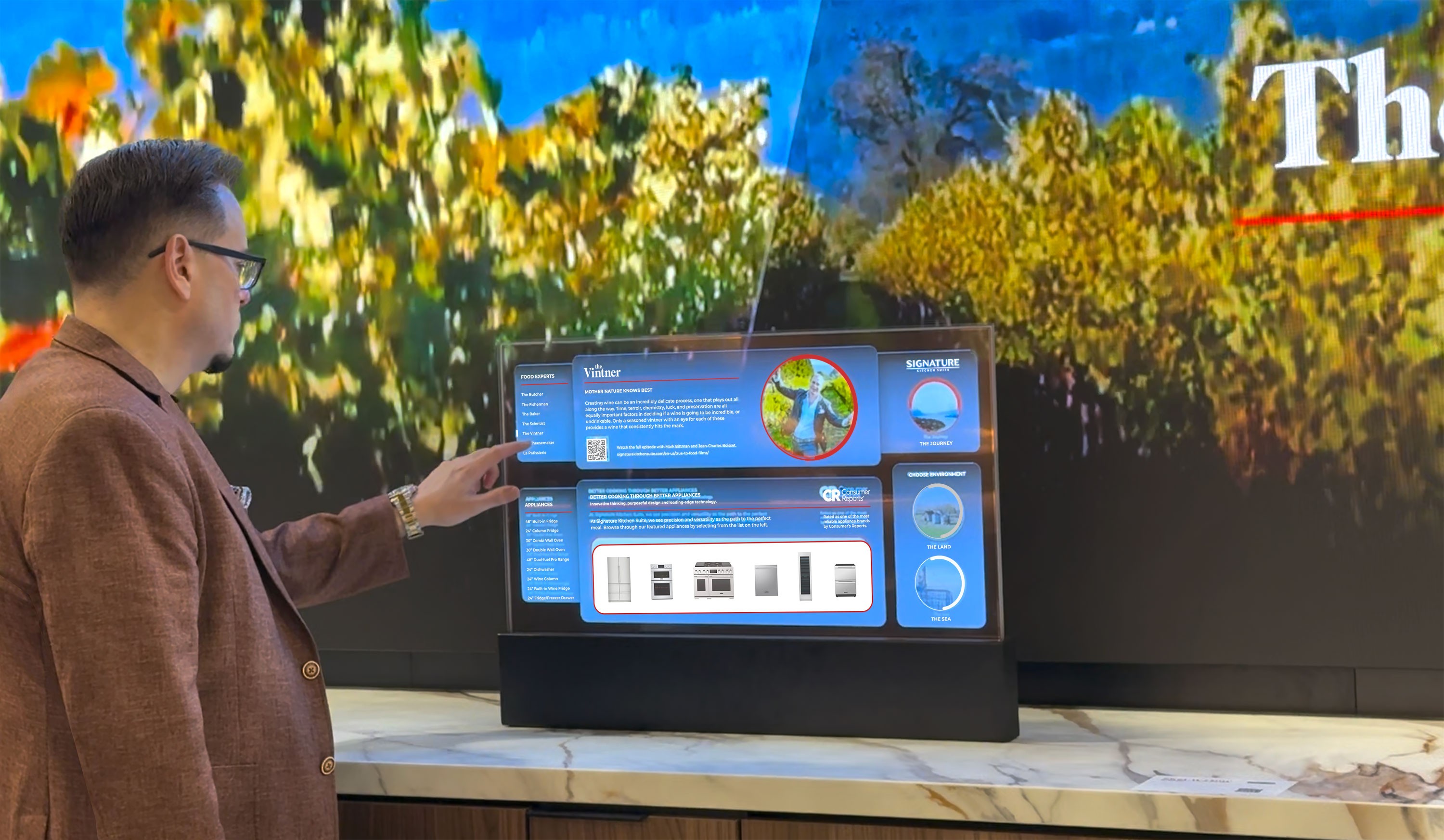
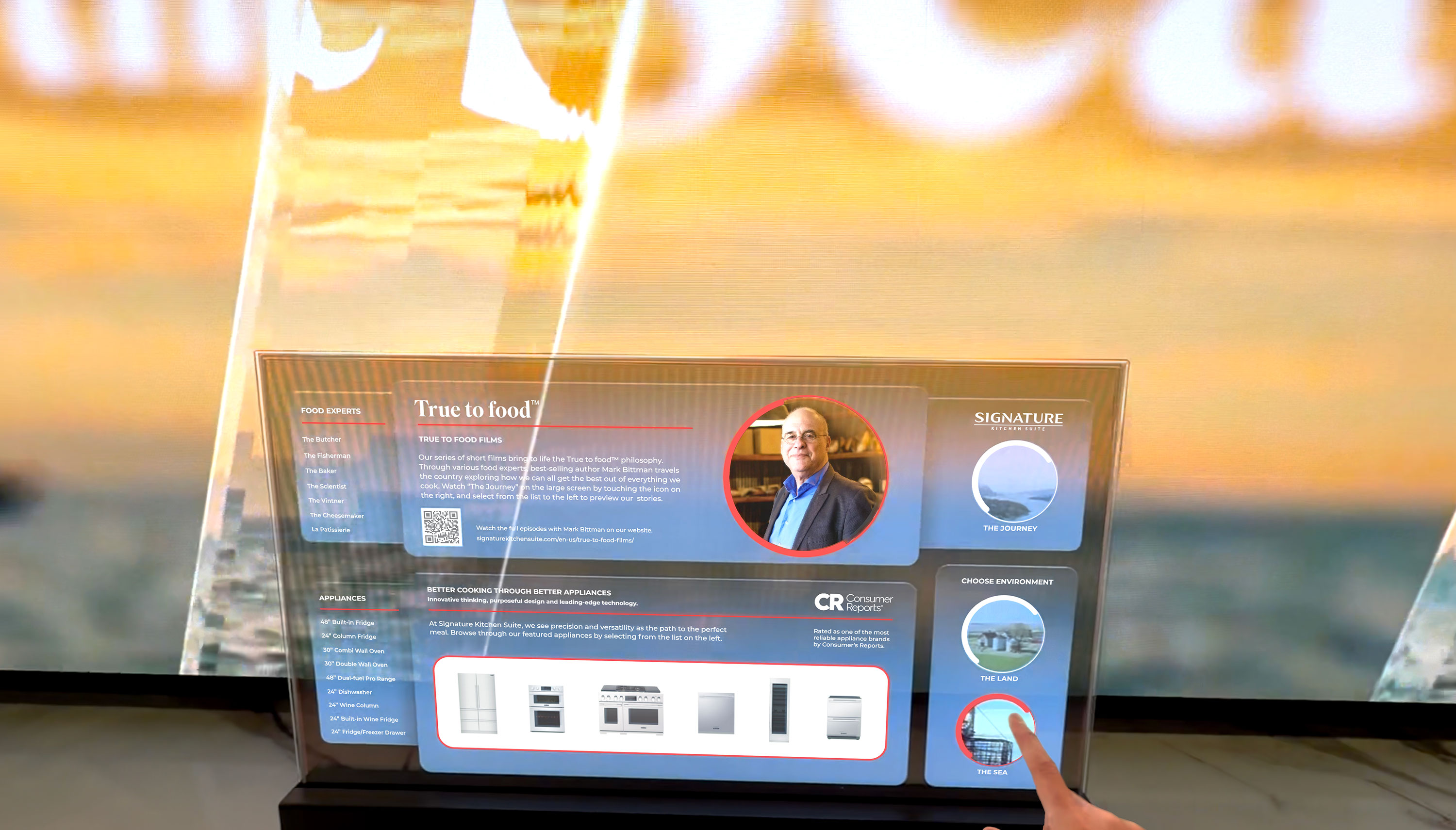
Utilizing multiple digital canvases together can add an additional element of depth. In this example above for LG’s Signature Kitchen Suite Booth at The Interior Design Show, our main content is on a larger LED wall and a smaller transparent touch OLED acts as the control display in front. This is a great interactive application for transparent touch displays, as functional layered technology to augment physical environments.
Conclusion

As digital experiences and display technology continue to evolve, their integration into Spatial Design is poised to reshape the way we perceive and interact with physical environments. If we begin by analyzing spatial design thinking across both physical and virtual experiences, it can provide new perspective for designing immersive environments. Spatial UX design focuses on creating experiences that seamlessly blend into their environments, enhancing specific individual user engagement and interaction. It emphasizes the importance of context, immersion, and spatial awareness to deliver intuitive and meaningful content which is just as important as technology. By seamlessly blending digital and physical brands can provide environments that are not only functional and aesthetically pleasing but also immersive and responsive to the needs of today’s customers. The future of spatial design lies at the intersection of technology and user experience, where immersion and transparency open new doors to creativity and innovation. As we adopt these new yet familiar strategies, a natural acceptance and even desire for multi-layered experiences will help augment the future of retail design.

MORE THOUGHTS

MORE THOUGHTS

November 14, 2024

DCX Summit: Immersive Spatial Design

November 14, 2024

DCX Summit: Immersive Spatial Design

May 31, 2024

Immersive Spatial Design

May 31, 2024

Immersive Spatial Design

May 2, 2021

NXTLVL Experience Design Podcast: Making Customers Experiential Partners

May 2, 2021

NXTLVL Experience Design Podcast: Making Customers Experiential Partners

Let's Connect

Or Email

On Linkedin

Let's Connect

I'll be speaking at ISE in Barcelona

Feb. 3-6, 2026

I'll be speaking at ISE in Barcelona

Feb. 3-6, 2026

I'll be speaking at ISE in Barcelona

Feb. 3-6, 2026